

A few years ago, many phishing emails were easier to spot because they contained awkward grammar, poor translations, or formatting mistakes. Those clues were never reliable, but generative AI has made them even less useful.
Attackers can now use widely available AI tools to draft polished messages, localize them into multiple languages, and quickly adjust tone, urgency, and subject matter. Microsoft and OpenAI have both documented threat actors using language models alongside traditional tools to support social engineering and phishing operations. That does not mean every polished phishing email was written by AI, but it does mean bad grammar is no longer a dependable warning sign.
The Phishing Email Factory
Consider a basic delivery-themed lure. An attacker can create a message claiming that a package could not be delivered, add a tracking number, impose a deadline, and direct the recipient to a fake payment or address-verification page. Delivery notices, password resets, invoices, shared documents, and internal policy messages are all common phishing themes because they create urgency and look familiar.
AI lowers the cost of producing variations of those messages. Attackers can change the language, company name, role, deadline, or emotional trigger far faster than before. They can also combine AI-generated text with stolen branding, compromised websites, public information, and phishing-as-a-service infrastructure.
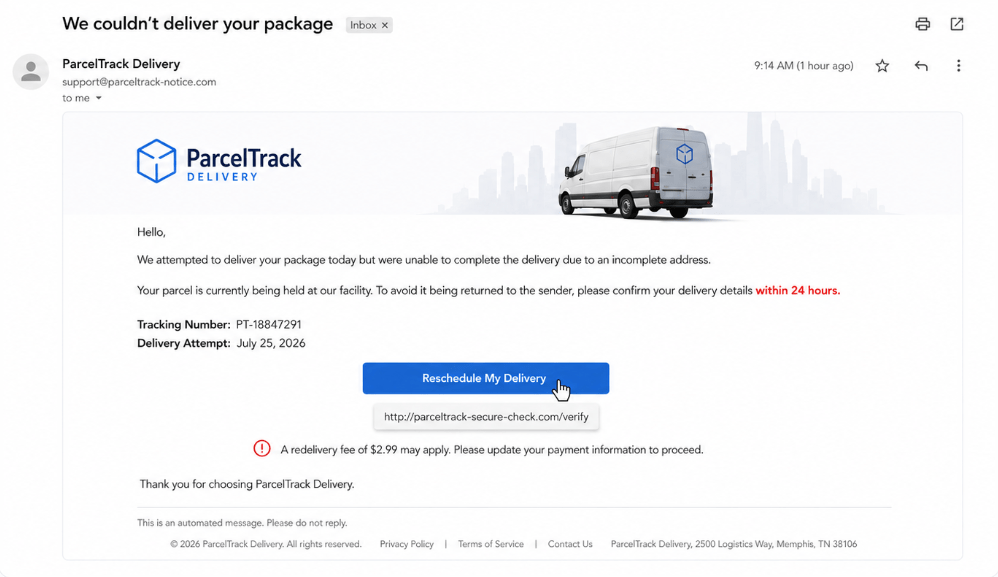
The economics favor the attacker. A campaign does not need to fool everyone. A small number of successful interactions may be enough to steal credentials, payment information, authentication tokens, or other sensitive data.
One Click Is a Signal, Not Automatic Compromise
Clicking a phishing link does not automatically mean an account or network has been compromised. The outcome depends on what happens next: whether the user enters credentials, approves a login, opens a malicious attachment, installs software, or completes another requested action.
However, links can contain tracking identifiers that tell an attacker that a message was opened or clicked. That information may make a recipient more attractive for follow-up attempts. Attackers can then test other themes, impersonate trusted organizations, or use personal details gathered from public sources and earlier interactions.
Over time, a successful social-engineering campaign may expose login credentials, payment data, contact information, business relationships, or internal context. The FBI has repeatedly warned that criminals use spoofed email accounts, familiar names, social media information, and compromised email threads to make later requests appear legitimate.
Security Tools Still Matter
Organizations often invest in endpoint detection and response, security information and event management, security operations centers, email filtering, identity protection, and multifactor authentication. Those controls can block malicious files, detect unusual activity, and contain incidents.
It would be inaccurate to say that one click makes those investments useless. Layered controls are specifically designed to prevent a single mistake from becoming a full compromise. Phishing-resistant multifactor authentication, conditional access, browser protections, endpoint controls, network segmentation, and rapid incident response can all reduce the blast radius.
But technology cannot eliminate social engineering. If an attacker obtains valid credentials or a valid session token, some malicious activity may initially resemble normal user behavior. That is why email security must include both technical controls and trained employees.
The Human Layer Should Be Designed, Not Blamed
Users need to know how to recognize suspicious messages, verify unexpected requests through a separate communication channel, inspect links, question urgent payment demands, and report suspicious emails quickly.
Security awareness training is supported by guidance and research from organizations such as NIST, which studies phishing detection difficulty and the role of user context. But training should not be reduced to blaming employees or measuring failure only through click rates. Reporting behavior, response speed, and the quality of the organization’s safeguards matter too.
A trained employee who reports a suspicious message can help security teams block related senders, remove similar emails from other inboxes, investigate exposed accounts, and warn the rest of the organization.
Attackers are using AI to make phishing faster, more polished, and easier to personalize. The answer is not to expect employees to become cybersecurity experts. It is to combine strong technical controls with practical training and a reporting process that turns human judgment into an active layer of defense.
Related Reading
Executive Checklist
Key Takeaways
- Generative AI makes polished phishing content faster and cheaper to produce.
- A single click can help attackers refine and personalize future attacks.
- Security tools matter, but they cannot fully remove human trust from the attack surface.
- Awareness training and simple reporting processes turn employees into active defenders.